


Specification
| Class | B |
| Rig | 15th-Century Replica |
| Height (m) | 25 |
| Overall length (m) | 26 |
| Nationality | Spain |
| Year built | 2017 |
| Home port | Huelva |
Biography
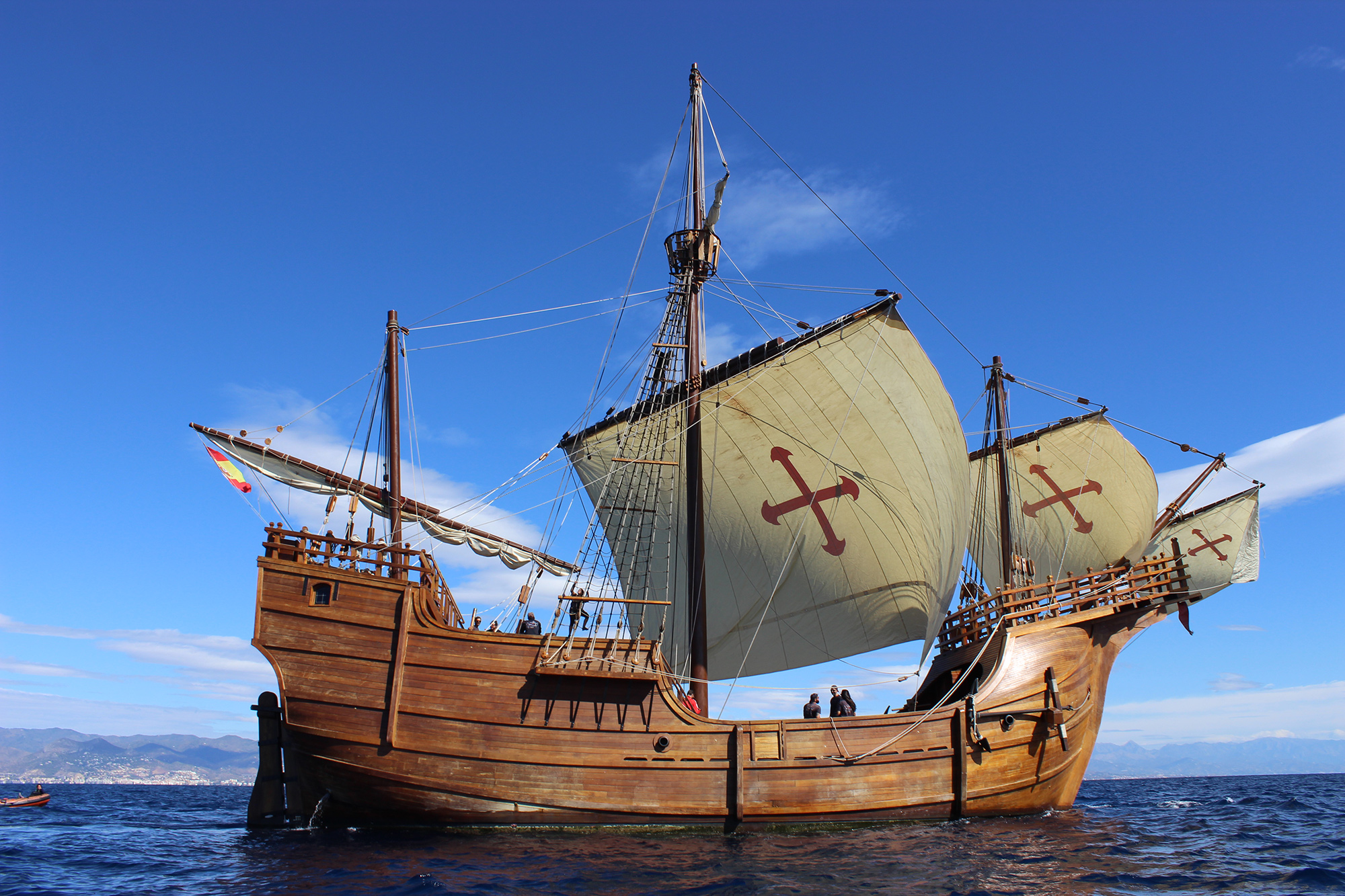
The Santa María was one of the most famous ships in history. On 12 October 1492, she took part in the historical voyage that led to the discovery of the Americas, under the command of Christopher Columbus. She left the port of Palos de la Frontera (Huelva) on 3 August 1492 as the flagship of the famous “Three Caravels”, which she formed together with the Pinta and the Niña. Whenever Columbus mentioned the Santa María in his famous expedition journal, the admiral described her as a carrack, as did other chroniclers of the time: “Christopher Columbus chartered, besides those two, a carrack… and for the third, which was a little larger than the others, he wanted to set off himself, and it was in this way that she became the flagship.
She was purchased for Columbus’s expedition by the Spanish crown, for Juan de la Cosa, a Cantabrian living in El Puerto de Santa María at the time. It is generally believed that she was built somewhere along the Galician coast, hence her former name: La Gallega.
The Santa María and her 40-strong crew arrived in America with the other caravels on 12 October 1492, thus playing a decisive role in one of the most significant encounters in history. On Christmas day that same year, she ran aground off the island of Hispaniola and sank due to the negligence of the cabin boy at the helm. The remains of the ship were used to build Fort Navidad, the first Spanish settlement in the Americas, at the site of the wreck in Caracol Bay (Haiti).
In 2018, the Nao Victoria Foundation built a full-scale replica of Nao Santa María to mark the 525th anniversary of the “the Encounter between Two Worlds”.